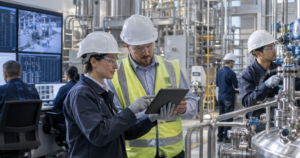
Chemical production has always depended on precision. Temperatures, pressures, mixing speeds, ingredient ratios, batch timing, equipment condition, and quality standards must all remain within carefully controlled limits. What has changed is the amount of information now available to manage those variables. Modern plants are increasingly built around connected systems that capture operating data, analyze conditions, coordinate production, and give teams a clearer view of what is happening across an entire facility.
Information technology is no longer limited to the offices surrounding a manufacturing plant. It now reaches directly into production, maintenance, quality assurance, inventory management, logistics, cybersecurity, and customer communication. This shift is especially important for contract chemical producers that may manufacture many different formulations for multiple customers, each with its own specifications, schedules, documentation, and quality requirements.
As digital systems become more deeply integrated with industrial equipment, IT is moving from a supporting role to the infrastructure that connects nearly every part of the manufacturing process.
The Factory Floor Is Becoming a Data Environment
Modern manufacturing equipment can generate an enormous stream of operational information. Sensors can continuously monitor temperature, flow, pressure, vibration, energy consumption, tank levels, production speed, and other variables that once required manual readings or periodic inspections.
The broader concept of information technology described by Wikipedia includes the systems used to create, process, store, retrieve, and transmit information. In an industrial environment, those capabilities can be applied directly to production data.
Instead of relying solely on operators to recognize changes in a process, connected systems can make those changes visible immediately. Historical data can also be stored and compared with current operating conditions. That gives plant teams a much stronger foundation for identifying patterns, finding inconsistencies, and understanding how different production variables affect an outcome.
Data becomes particularly valuable when a facility handles numerous formulations. A digital production history can help teams compare batches, confirm operating conditions, document adjustments, and create a much clearer record of how products were manufactured.
The result is a factory floor where information moves almost as continuously as the materials being processed.
Artificial Intelligence Is Moving Into Industrial Operations
Artificial intelligence is also finding a practical role inside industrial environments. The technology is not simply being used to generate reports or automate office work. Industrial AI can analyze operational data, detect patterns, support predictive maintenance, optimize processes, and help manufacturers make faster decisions.
The 2026 NIST Roadmap on Artificial Intelligence and Machine Learning for Smart Manufacturing describes advances involving industrial data analytics, sensing, autonomous systems, digital twins, robotics, logistics, and sustainable manufacturing.
These technologies have significant implications for chemical facilities.
A production system that continuously analyzes temperature, pressure, flow, mixing behavior, and other process data may be able to identify unusual conditions earlier than traditional monitoring methods. Maintenance teams can use operating data to recognize equipment behavior that may indicate wear. Production managers can compare performance across batches and potentially identify opportunities to reduce unnecessary downtime or improve scheduling.
IBM’s overview of industrial AI also highlights the growing connection between artificial intelligence, industrial Internet of Things devices, sensors, robotics, digital twins, edge computing, and real-time operational information.
The important development is not any single AI application. It is the ability to connect information from many parts of an industrial operation and use that information to support better decisions.
Automation Is Becoming More Intelligent
Automation has been part of chemical processing for decades, but connected IT infrastructure changes what automation can accomplish.
Traditional automation may control a specific valve, mixer, pump, temperature range, or production sequence. Modern digital systems can connect information from multiple pieces of equipment, databases, production schedules, inventory systems, and quality records.
That creates the possibility of much more coordinated manufacturing.
A system may track whether the correct raw materials are available before a batch begins. Production software can record when ingredients are introduced, monitor important operating parameters, and maintain electronic production records. Finished-product information can then move into inventory and logistics systems with less manual reentry.
This type of integration reduces the number of information gaps between departments.
Microsoft describes intelligent manufacturing environments as using data and AI to improve visibility and identify optimization opportunities through its manufacturing technology resources.
For chemical producers, improved visibility can be especially valuable because manufacturing rarely occurs in isolation. Production must remain coordinated with raw-material availability, equipment scheduling, laboratory testing, packaging, storage, transportation, and customer deadlines.
Digital Twins Are Creating New Ways to Understand Production
One of the more interesting developments in industrial IT is the digital twin. A digital twin is a digital representation of a physical system, process, or asset that can use real operating data to help organizations understand performance.
For chemical operations, the concept offers possibilities far beyond creating a digital diagram of a plant.
Equipment behavior, production conditions, sensor data, maintenance records, and process information can potentially be brought together in a digital environment. Engineers and production teams can use these models to better understand relationships between operating conditions and manufacturing outcomes.
The U.S. Department of Energy has highlighted the role of real-time information and digital twins in the broader transformation of manufacturing. Its discussion of advanced manufacturing and industrial productivity describes the integration of information from machines, products, processes, and supply chains into digital systems that can support decision-making.
Digital twins may eventually allow manufacturers to evaluate changes virtually before making certain adjustments to physical operations. They can also help companies understand complex relationships that are difficult to recognize when production information remains scattered across separate systems.
Predictive Maintenance Can Reduce Unplanned Disruptions
Unexpected equipment failure can disrupt production schedules, create expensive downtime, delay customer orders, and place additional pressure on maintenance personnel.
IT is changing maintenance by allowing manufacturers to move beyond schedules based primarily on calendar intervals.
Sensors and industrial monitoring systems can collect information about vibration, temperature, pressure, runtime, energy consumption, and other indicators of equipment condition. Software can then analyze those measurements over time.
A pump that begins operating differently from its historical baseline may warrant inspection. An unusual vibration pattern may indicate that a component is beginning to deteriorate. Changes in motor performance could provide another early indication that maintenance is needed.
Predictive maintenance does not eliminate mechanical problems, but better information can help maintenance teams focus attention where it is most valuable.
It can also improve maintenance planning. When teams have greater visibility into equipment condition, they may be able to schedule work during planned production gaps rather than responding to unexpected failures in the middle of a critical batch.
Quality Control Is Becoming More Connected
Quality has always been central to chemical manufacturing, and information systems are making quality documentation considerably more sophisticated.
Digital records can connect production conditions with laboratory results, raw-material information, equipment settings, timestamps, batch numbers, and operator activity. Instead of viewing quality testing as an isolated step at the end of production, manufacturers can build a digital record that follows a batch throughout its lifecycle.
This creates better traceability.
If a finished product does not meet a specification, teams can review the production history in greater detail. They may be able to compare the affected batch with previous batches and identify differences in materials, equipment behavior, operating conditions, or process timing.
Over time, that information becomes an operational knowledge base.
The value is not simply faster recordkeeping. Connected quality information can help manufacturers understand why processes behave differently and where improvements may be possible.
Supply Chains Are Becoming Part of the Same Digital Network
Production efficiency means little if the required raw materials are unavailable or finished products cannot reach customers on schedule.
That is why modern manufacturing IT increasingly extends beyond the plant itself.
Inventory systems can provide greater visibility into raw-material quantities, expected deliveries, production demand, and finished goods. Enterprise platforms can connect purchasing information with manufacturing schedules. Logistics software can coordinate outbound shipments while customer systems provide updates about order requirements.
When these systems communicate, manufacturers gain a broader view of operations.
A change in a customer order can affect material requirements, scheduling, packaging, warehouse space, and transportation. Connected information systems help teams see those relationships sooner.
This is particularly important for manufacturers serving multiple customers because production priorities may change quickly. Better digital coordination makes it easier to adjust schedules without losing visibility across the rest of the operation.
Cybersecurity Is Now an Industrial Issue
Connecting production equipment to digital networks creates tremendous opportunities, but it also creates responsibilities.
Manufacturing facilities increasingly operate with a combination of information technology and operational technology. As those environments become more interconnected, cybersecurity must extend beyond traditional office computers and business software.
The Cybersecurity and Infrastructure Security Agency provides extensive industrial control systems security guidance covering vulnerabilities, incident response, remote access, defense-in-depth strategies, and other industrial cybersecurity concerns.
NIST has also emphasized this growing connection. Its 2026 cybersecurity guidance for manufacturing notes that increased interconnection between operational technology and IT networks can expose industrial operations to cyber risks that may affect production, safety, and resilience.
For chemical manufacturers, this makes cybersecurity part of operational reliability.
Network segmentation, access controls, secure remote connections, software updates, monitoring, backups, incident-response planning, and employee training are increasingly important parts of maintaining a modern facility.
The goal is not to avoid connectivity. It is to build connected manufacturing environments with security incorporated into the infrastructure from the beginning.
Cloud and Edge Computing Are Changing Where Information Is Processed
Industrial data does not always need to be processed in the same place.
Cloud computing allows companies to centralize certain information and applications, making data accessible across facilities, departments, and authorized users. Edge computing takes another approach by processing selected information closer to the machinery or sensors generating it.
The two approaches can work together.
Some manufacturing decisions require extremely fast responses and may be better handled near the equipment. Other information may be transferred to centralized platforms for long-term storage, analytics, reporting, or comparisons across different facilities.
This hybrid approach allows companies to decide where information should be processed based on speed, security, reliability, and operational requirements.
It also supports a larger shift toward manufacturing environments in which information is available to the people who need it without requiring every decision to be made from the factory floor.
IT Is Improving Customer Visibility
Technology is also changing the relationship between contract manufacturers and their customers.
Customers increasingly expect access to accurate production information, documentation, inventory status, shipping updates, quality records, and other data associated with their products.
Digital systems can make that information easier to organize and retrieve.
Production records that once existed across paper files, spreadsheets, emails, and separate databases can be brought into more coordinated systems. This can make customer reporting faster and help manufacturing teams respond more efficiently when clients request documentation.
Better information flow can also improve collaboration. When manufacturers have accurate data about production capacity, material availability, and scheduling, they can communicate more clearly about timelines and potential constraints.
In a competitive manufacturing market, information itself becomes part of the service.
Human Expertise Remains at the Center of Digital Manufacturing
The rapid growth of AI and automation sometimes creates the impression that manufacturing is moving toward facilities where software makes every decision.
Industrial operations are far more complicated than that.
Chemical production requires experienced operators, engineers, maintenance technicians, laboratory professionals, safety personnel, supply-chain specialists, and managers who understand both the process and the consequences of operational decisions.
Technology gives those professionals better tools.
A sensor can detect a change in pressure, but experienced personnel understand what that change means within the larger process. Analytics software can highlight an unusual trend, while engineers determine whether it represents a meaningful problem. AI can identify patterns across thousands of data points, but people still provide process knowledge, context, oversight, and accountability.
The strongest digital manufacturing strategies therefore combine technology with industrial expertise rather than treating one as a replacement for the other.
Conclusion
The modern Toll Chemical Manufacturing plant is becoming a connected information environment as much as a physical production facility. Sensors collect data from equipment. Software coordinates workflows. AI analyzes patterns. Digital twins provide new ways to understand processes. Predictive maintenance systems help protect uptime. Cloud platforms connect information across organizations, while cybersecurity safeguards increasingly interconnected industrial networks.
These technologies are changing the role of IT inside manufacturing.
IT departments are no longer responsible only for computers, email, servers, and business applications. Their work increasingly touches production reliability, process visibility, data integrity, quality documentation, supply-chain coordination, cybersecurity, and long-term competitiveness.
That transformation will continue as industrial systems become more connected and more intelligent. Chemical manufacturers that build strong digital foundations will be positioned to use their operational information more effectively, adapt faster to changing production demands, and create manufacturing environments where people, equipment, and data work together as one coordinated system.